Global commerce is accelerating, but speed introduces significant cybersecurity risks. As B2B collection operations digitize, technology teams face a dual challenge: building high-performance payment architectures while navigating complex global data standards and local privacy laws.
For CTOs and product architects, the question isn't just about code efficiency; it is about architectural survival. How do you build a high-volume B2B payment infrastructure that is immune to legal risk and cyber threats?
Executive Summary: When a B2B collection platform operates as a "Service Provider" and processes over 300,000 transactions annually, it triggers mandatory PCI DSS Level 1 certification and on-site QSA audits. This requires a transition to v4.0 standards, including Multi-Factor Authentication (MFA), strict tokenization, and "Open Consent" management under data privacy laws like KVKK.
The Core Challenge: Balancing Speed with Compliance
Legacy, paper-based open accounts are being replaced by ERP-integrated digital collection platforms. However, this digital transformation exposes technology firms to a labyrinth of regulations. Software companies must design infrastructures that satisfy strict global security protocols without sacrificing the operational speed required by modern business.
The PCI DSS Ecosystem in B2B
The Payment Card Industry Data Security Standard (PCI DSS) is not merely a technical checklist; for B2B software, it is the gatekeeper for banking integration.
Defining Your Role: Merchant vs. Service Provider
A critical error in architectural planning is misclassifying the business role. In B2B, the lines often blur.
Merchant: An entity accepting payment for its own goods or services (e.g., a distributor collecting from its own dealer network).
Service Provider: An entity that processes, stores, or transmits payment data for another business.
Crucial Note: If you offer a Online collection portal as a SaaS (Software as a Service) to multiple companies, the PCI Council classifies you as a Service Provider.
Transaction Thresholds: The "Level 1" Trap for SaaS
PCI DSS compliance levels are dictated by annual transaction volume. However, the threshold for Service Providers is significantly lower than for Merchants, creating a "compliance trap" for growing SaaS platforms.
Compliance Level Criteria (Visa/Mastercard Standards)
Compliance Level | Merchant Criteria (Own Goods) | Service Provider Criteria (SaaS/Fintech) | Validation Method |
Level 1 | > 6 Million transactions/year | > 300,000 transactions/year | QSA On-Site Audit + ROC |
Level 2 | 1 - 6 Million transactions/year | < 300,000 transactions/year | SAQ D + (Optional QSA) |
Level 3 | 20k - 1 Million (e-commerce) | N/A | SAQ |
The Analysis: The 300,000 transaction limit is easily breached by B2B platforms. A platform averaging just 822 transactions per day automatically falls into the highest risk category (Level 1). Startups that ignore this incur massive technical debt. Architects must build for Level 1 compliance from Day 1.
PCI DSS v4.0: Technical Deep Dive
The shift to v4.0 moves compliance from a static checklist to a "Continuous Security" model.
1. Network Security Controls (NSC) & Micro-Segmentation
The traditional "firewall" concept has evolved into "Network Security Controls".
Container Security: Cloud-native B2B software must inspect traffic between internal containers (Docker/Kubernetes), not just the perimeter.
Micro-Segmentation: Servers must be isolated. The internet-facing DMZ should only expose port 443 (HTTPS), while database servers must remain completely cut off from the internet, accepting requests solely from application servers.
2. Zero Trust & Phishing-Resistant MFA
Under v4.0, Multi-Factor Authentication (MFA) is no longer just for remote access. It is mandatory for any access to the Cardholder Data Environment (CDE).
Zero Trust Architecture: Based on NIST principles, the system must never implicitly trust any user or device inside the network.
Hardware Keys: Implement FIDO2 hardware keys to combat sophisticated phishing attacks.
3. Client-Side Security (Web Skimming Protection)
To counter Magecart attacks, v4.0 (Req 6.4.3) mandates strict control over payment pages. B2B software must maintain an inventory of all running scripts and trigger immediate alarms if unauthorized changes are detected in third-party tools (like analytics or chat widgets).
The Intersection of Data Privacy (KVKK) and PCI DSS
Software operating in Turkey must harmonize PCI technical standards with the Law on Protection of Personal Data (KVKK).
The Conflict: PCI DSS focuses on the Primary Account Number (PAN). However, KVKK classifies associated data (cardholder name, IP address) as PII (Personally Identifiable Information). While PCI doesn't mandate encrypting the cardholder's name alone, KVKK requires "appropriate security levels" for all PII. +1
The Solution: Compliance teams should adopt the strictest standard, often applying Transparent Data Encryption (TDE) across the entire database.
Card Storage Consent: You cannot use pre-ticked "Save my card" boxes. KVKK explicitly requires "Explicit Consent" from the user—a positive, voluntary action—to store card credentials.
Descoping Strategy: "The Best Data is No Data"
To reduce audit scope and liability, smart architectures utilize Descoping via Tokenization.
Tokenization & Hosted Fields (iFrame)
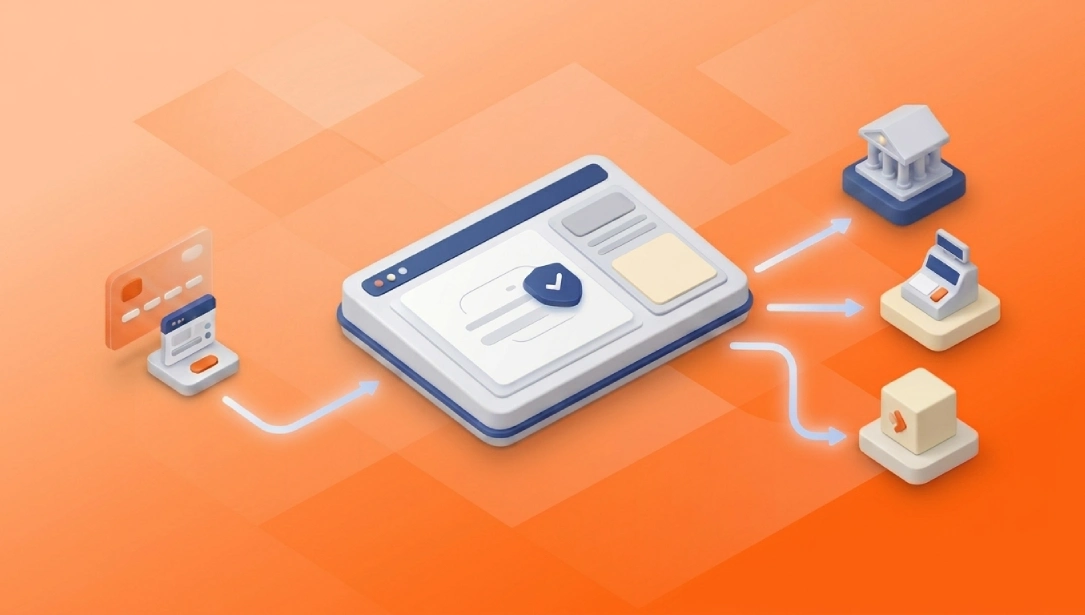
When a user enters card details, the data should never touch your application servers.
Hosted Fields: Use iFrames to capture data directly to a licensed PSP (Payment Service Provider).
Tokenization: The PSP processes the data and returns a mathematically irreversible "Token" to your system.
Security: Even if hackers breach your database, they only steal meaningless tokens, not card numbers. This drastically reduces your PCI DSS audit scope.
Critical Architecture: Reliability & ERP Integration
In B2B, a payment is only successful if it reconciles with the ERP (SAP, Netsis, Logo, etc.).
Atomic Settlement: The payment capture and ERP write-back must happen simultaneously. If the network fails, the system must trigger an automatic Rollback.
Idempotency Keys: To prevent double-charging during connection timeouts, every API call must carry a unique Idempotency Key. If the ERP sees the key twice, it rejects the duplicate request.
Active-Active Redundancy: Level 1 systems cannot afford downtime. Infrastructure must be geographically redundant (e.g., separate data centers), with Global Load Balancers capable of shifting traffic in seconds during a disaster.
Frequently Asked Questions (FAQ)
Is it legal for B2B software to store credit cards? Yes. It is legal provided you obtain 'Explicit Consent' under KVKK Article 5 and use tokenization to isolate real card data from your systems.
Which companies are mandated to get PCI DSS Level 1? Any B2B technology firm acting as a "Service Provider" that processes over 300,000 card transactions annually must obtain this certification.
What is the difference between Tokenization and Encryption? Encryption hides data with a key (reversible). Tokenization replaces data with a random, mathematically unrelated value (irreversible by the merchant), keeping the real data in a secure external vault.
What are the reporting obligations during a data breach? The Software Provider (Data Processor) must notify the client (Data Controller) immediately upon detection. The Data Controller then has 72 hours to report the breach to the Personal Data Protection Authority (KVKK) and notify affected individuals.
Eliminate Compliance Risk with Netahsilat
Building a PCI DSS v4.0 Level 1 compliant infrastructure in-house requires months of development, expensive audits, and ongoing maintenance.
Don't build technical debt. Leverage Netahsilat’s proven infrastructure, trusted by over 5,000 enterprise firms to manage 630 Billion TL in annual volume. Ensure your B2B collections are secure, compliant, and scalable from day one.
Discover Netahsilat Solutions - Request a Free Demo